
The business you built outgrew the founder it needs
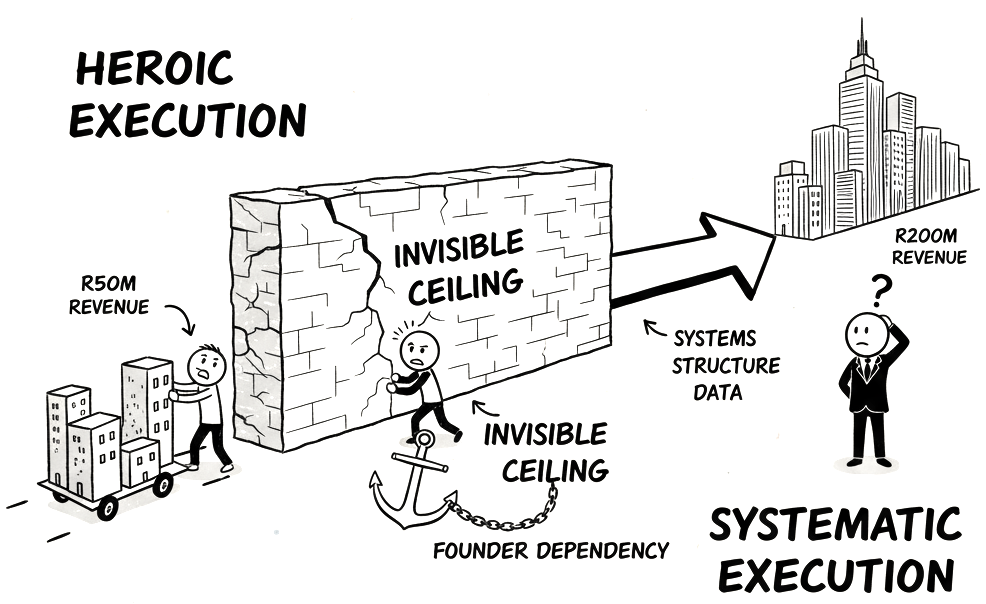
The Scale-Up Inflection Point: Why What Got you to R50m* won't Get you to R200m*
You've done it. You've built something real. R50 million in revenue*, a team that knows what they're doing, customers who actually pay you. You're past the startup chaos, past the "will we make payroll" panic attacks.
But something's off. Growth is slowing. Your best people are frustrated. You're working harder than ever, but the business isn't moving as fast as it used to. Welcome to the scale-up inflection point - the playbook that got you to R50m is broken At R100m*. Could it be that the business is now bigger than you?
*pick a number, any number.
The Invisible Ceiling
In three decades of working with South African tech companies, I've seen this pattern repeat itself with uncomfortable predictability. The systems and approaches that got you to R50m* become the very things holding you back from getting to R200m*. It's not a failure of effort or intelligence. It's structural.
At R50m*, you can still run the business through force of will and personal relationships. The CEO knows every major client. The leadership team communicates through WhatsApp and hallway conversations. Decisions get made quickly because everyone's in the loop.
At R200m*, that model breaks. Completely.
The Three Breaking Points
The transition from R50m* to R200m* typically breaks in three places:
Decision-making velocity. What used to take a quick conversation now requires alignment across teams you don't directly manage. Your instinct is to pull decision-making back to yourself, which creates a bottleneck. The business can't move faster than you can think.
Customer intimacy at scale. You can't know every customer anymore. Your sales team is closing deals with companies you've never heard of, in segments you didn't plan for. That's growth, but it's also terrifying. Are they the right customers? Is your product actually solving their problems? You're flying blind.
The founder's skillset mismatch. You built this business through hustle, relationships, and technical insight. But R200m* requires different capabilities: talent development, process design, capital allocation, organisational design. These aren't worse skills, they're different skills. And some founders haven't developed them yet.
What Actually Needs to Change
The hard truth is that you need to fundamentally rewire how your business operates. Not optimize. Rewire.
You need to shift from heroic execution to systematic execution. That means documenting the implicit knowledge in your leaders' heads, building repeatable processes, and creating feedback loops that catch problems before they become crises.
You need to move from relationship-based coordination to structure-based coordination. Your org chart needs to actually mean something. Roles need clear ownership. Decision rights need to be explicit. This feels bureaucratic when you're used to moving fast and fluid, but ambiguity is expensive at scale.
You need to transition from intuition-driven decisions to data-informed decisions. Not data-driven (your instincts still matter), but informed. You need dashboards that tell you the truth about what's working and what isn't, before your gut feel catches up.
The CEO's Job Changes
Your job at R50m is to be the best player on the field. Your job at R200m is to be the coach who builds the system that develops great players.
That shift is uncomfortable. It means letting go of things you're good at. It means watching your team make decisions you would have made differently. It means building infrastructure that feels like overhead until the moment it saves you from catastrophe.
But here's the opportunity: the companies that navigate this transition successfully don't just grow bigger. They grow better. They build organisations that can scale without burning out their people. They create value that isn't dependent on the founder's personal heroics.
What to Do Tomorrow
1) Start with an honest assessment. Look at your last ten strategic decisions. How many required you personally to make the call? If it's more than half, you have a dependency problem.
2) Look at your leadership team. Can they articulate the strategy clearly and consistently without you in the room? If not, your strategy isn't clear enough yet.
3) Look at your systems. When something goes wrong, do you add a process or do you just work harder? If it's the latter, you're not building infrastructure, you're building fragility.
4) The scale-up inflection point is real, and it's brutal. But it's also the moment when good companies become great ones. The question isn't whether you'll face it. The question is whether you'll recognise it in time to do something about it.
At CtrlFuture, we've had front-row seats to the genius of founders for 30 years. We've seen their vision and resilience build incredible companies from scratch.
But we've also seen many hit an invisible wall—a point where their initial strengths create a growth ceiling. This is "The Founder's Paradox".