
When Great Salesmanship Becomes the Constraint
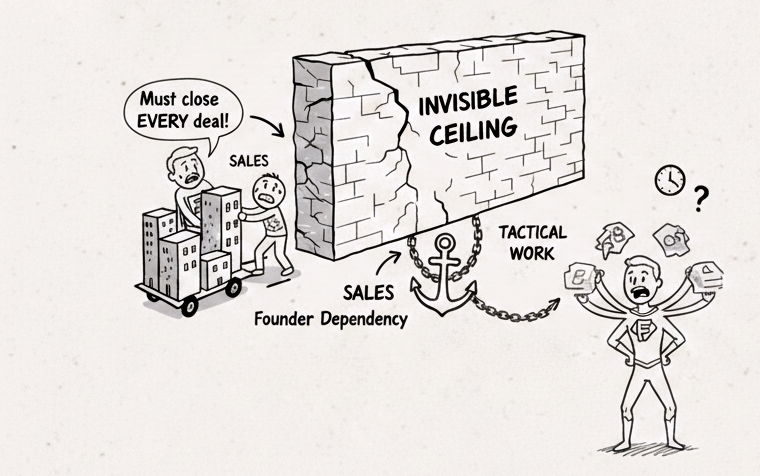
Most founders are exceptional salespeople.
That’s not an accident — it’s why the business exists at all.
You built momentum through personal credibility, deep customer insight, and an ability to close deals others couldn’t. You hired people, growth stalled, and you stepped in. When a deal went cold, you revived it. When something really mattered, you sold it yourself.
And that’s exactly what got you here.
It’s also what is starting to hold you back.
The Founder-Seller Trap
There’s a moment in every scale-up where the founder’s sales strength becomes the bottleneck. Not because you’re doing it wrong — but because you’re doing too much of it.
You personally selected your sales team because they had proven they could deliver results.
But now they seems to be waiting for you to close.
Prospects still expect to meet you before they sign.
Big deals don’t move without your involvement.
You haven’t built a sales engine.
You’ve built a sales dependency.
From zero to somewhere, this works. Beyond that, it breaks — mathematically and strategically. There simply aren’t enough hours in your day to personally carry revenue and lead the business forward.
And every hour you spend selling is an hour you’re not:
- Building repeatability
- Refining strategy
- Creating systems
- Increasing enterprise value
The Hidden Cost of Staying in the Deals
When the founder remains the best salesperson, three things quietly stall:
1. The sales team stops developing
Why learn to close complex deals if escalation is the norm? You think you’re helping. You’re actually freezing capability growth.
2. Strategic thinking gets crowded out
Sales is urgent and tactical. Leadership is long-range and conceptual. The urgent wins — every time.
3. Value creation caps out
Personally closing deals adds revenue. Building a sales organisation that doesn’t need you adds multiples.
At scale, your job isn’t to win today’s deal.
It’s to build a company that wins without you.
The Real Transition (It’s Not “Stop Selling”)
The shift isn’t from sales to no sales.
It’s from executor to architect.
You move from:
- Closing deals → designing how deals get closed
- Being the hero → building heroes
- Intuition in your head → capability in the system
You stay involved where it matters:
- Strategic accounts and partnerships
- Deal structuring for complex opportunities
- Market insight and pattern recognition
- Coaching and developing senior sales leaders
But you stop being the default closer.
That part is uncomfortable. Some deals will wobble. A few may be lost. These are the school fees you need to pay to build a sales function that actually scales.
The Leadership Shift Most Founders Avoid
The hardest part isn’t operational — it’s identity.
Being a great salesperson is core to how many founders see themselves. Stepping back can feel like losing relevance.
The reframe is this:
Your superpower wasn't only closing deals.
It was building something from nothing.
At scale, that same superpower is expressed differently — through systems, leaders, and repeatable execution.
Every deal you close yourself is a short-term win and a long-term constraint.
Every capability you build compounds.
Where a Fractional CRO Fits
This transition is exactly where many founders get stuck — not because they lack insight, but because they’re too close to the action. Or they aren't ready to let go.
A Fractional CRO helps bridge the gap:
- Translating founder-led selling into repeatable sales leadership
- Deconstructing what you do well and embedding it into the team
- Building process, enablement, and management layers that scale
- Creating space for the founder to step into the CEO role the business now requires because there is confidence in the sales team
Not replacing the founder.
Not “consulting from the sidelines.”
But operating inside the business to transfer capability, reduce dependency, and unlock the next phase of growth.
You’ve already proven you can sell.
The real question is whether you can build an organisation that sells without you.
That’s the leadership transition that separates strong businesses from scalable ones.