
When you feel like you're losing your business to the people you hired
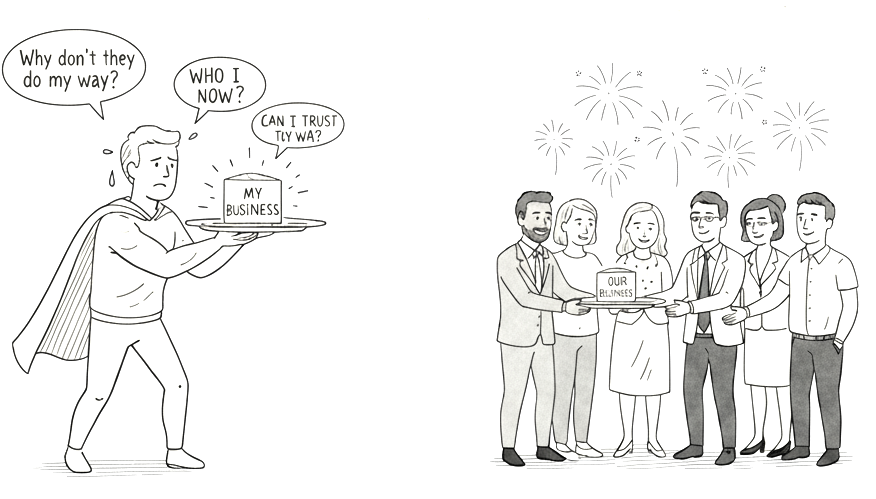
You built this company from the ground up, with your bare hands and sheer force of will. Every win, every fire fought, every line of code had your fingerprints all over it. You were successful, the business grew fast, you hired great people. Good move!
Learning to delegate is one thing; but handing over your business can trigger a deep, personal identity crisis, and it’s playing out while you're supposed to be steering the ship toward hyper-growth.
The Internal Struggle No One Talks About
This challenging of your leadership identity is creating an internal battle, and it could show up in a few key ways.
- The War Between Doing and Leading (not micromanaging)
You know you need to step back, but you also believe your direct involvement is what guarantees quality. This is the cognitive dissonance that has you hiring expensive leaders and then micromanaging their every move. You can't seem to fully trust the very people you hired to take the load off, creating a bottleneck that starts and ends with you. - Missing the Grind
Remember the rush of winning a deal or going live with a difficult project? Shipping a new product? There's a real sense of loss when you have to let go of that. You start to feel removed from the "real work" that creates value, and that emotional attachment to the old way of doing things stops you from embracing your new role as a coach and strategist. It’s a quiet kind of grief for the job you used to have. - Big League Imposter Syndrome
You were the undisputed expert in the early stages. But now, you're grappling with how to trust the latest forecast coming from sales when you haven't even heard of the client, navigating a landscape of competitors you've never faced before, entrusting quality to employees whose names you can't remember. The anxiety keeps you awake at night, and you're wondering if you're the right person to lead the company to the next level. This isn't the same imposter syndrome you felt at the start; this is a deeper doubt about your ability to handle the scale. - Married to Your Original Playbook
The strategies that got you to your first major inflection point are gospel. They're your "recipe for success." The problem is, growth requires a new recipe. When data screams for a pivot—a new go-to-market strategy or a different organisational structure—you resist. Not because you're stubborn, but because it contradicts the very rules that made you successful in the first place. You know what works! Don't you?
Why This Hits Hardest Right When You're About to Take Off
This internal battle couldn't come at a worse time. The inflection point is precisely when your company needs bold, decisive leadership.
Your hesitation creates a ripple effect of delays across the entire business. The new CRO can't build a scalable process because they're waiting for your approval. The Head of Product feels stifled, unable to truly own the product roadmap.
The culture you built, which was once centred on your vision, now struggles to evolve into one of empowerment and ownership. Your past successes create a strategic tunnel vision, making it hard to see the radically different paths you need to take to truly scale.
In the end, the biggest threat to your company's future isn't the market or a lack of capital. It's the internal war you, the founder, must wage to dismantle the very identity that brought you here.
Navigating this transition from founder-operator to visionary CEO is the hardest—and most important—work you will ever do. It’s the difference between hitting a plateau and building a legacy.
Redefine Your Role and Vision
The first step is to consciously shift your focus from the day-to-day operations to the bigger picture.
| Action | Description |
|---|---|
| Set a Clear Vision | Articulate a compelling vision for the company's future. This "North Star" will guide your decisions and help you prioritize strategic initiatives over daily tasks. |
| Shift from "Doing" to "Leading" | Your primary role is no longer about executing tasks, but about empowering others to do so. Focus on long-term strategy, market analysis, and resource allocation. |
| Embrace Strategic Detachment | Separate your personal identity from the business's success. This allows for more objective decision-making that is not based on ego. |
2. Build and Empower Your Team
You can't scale alone. The next crucial step is to build a team you can trust and empower them to take ownership.
| Action | Description |
|---|---|
| Hire People Smarter Than You | Surround yourself with a strong leadership team that has the expertise to manage their respective domains without your constant oversight. |
| Delegate and Trust | Let go of the need to be involved in every decision. Trust your team to execute, even if their methods differ from yours. This frees you up to focus on your new role as CEO. |
| Foster a Culture of Empowerment | Create a work environment where team members feel a sense of ownership and are not afraid to make decisions and even mistakes. |
3. Develop New Skills and Systems
The skills that got you here won't get you to the next level. Invest in your own growth and the systems that will enable the company to scale.
| Action | Description |
|---|---|
| Invest in Professional Development | Seek out a coach, mentor, or peer group to guide you through this transition. You are not the first founder to go through this, and you can learn from their experiences. |
| Shift to Data-Driven Decisions | While intuition is valuable in the early stages, scaling successfully requires a greater reliance on data and analysis to make informed, strategic decisions. |
| Implement Scalable Systems | Establish processes and systems that allow the business to run smoothly without your constant involvement. This is crucial for long-term sustainability and eventual exit strategies. |
4. Manage the Psychological Shift (and Don't Panic!)
This transition is as much an emotional journey as it is a strategic one. Acknowledge and address the psychological challenges with a clear head.
| Action | Description |
|---|---|
| Don't Panic | This might sound trivial, but it's the most important rule. Seeing your role change so fundamentally can be terrifying. Acknowledge that this feeling is a normal part of the scaling process. Panicking leads to rash decisions and clinging to old habits. Take a deep breath; this is a marathon, not a sprint. |
| Acknowledge the Grieving Process | It's normal to feel a sense of loss for your old, hands-on role. Acknowledge these feelings as valid and allow yourself to move forward without letting them dictate your actions. |
| Embrace a New Identity | See yourself as a "work in progress" and be open to evolving your professional identity. Experiment with new leadership behaviors and step outside of your comfort zone. |
| Separate Self-Worth from Business Performance | Your value as a person is not tied to the daily ups and downs of the business. This separation will allow you to lead with a clearer head and make better long-term decisions. |
By taking these steps, you can navigate the challenging, but ultimately rewarding, transition from a founder to a CEO who can lead their company to its full potential.